Polygon deploys Madhugiri hard fork, aims for 33% throughput boost

cointelegraphPublished on 2025-12-09Last updated on 2025-12-09

Abstract

Polygon has deployed the Madhugiri hard fork, targeting a 33% increase in network throughput and reducing block consensus time to one second. The upgrade includes support for three Fusaka Ethereum Improvement Proposals (EIP-7823, EIP-7825, EIP-7883), which improve efficiency and security by limiting gas consumption for heavy mathematical operations. It also introduces a new transaction type for Ethereum-Polygon bridge traffic and adds flexibility for future upgrades. This enhancement aims to better support high-frequency use cases like stablecoins and real-world asset (RWA) tokenization. The hard fork follows the recent Heimdall 2.0 upgrade, which significantly reduced finality times, despite a brief disruption in September due to a bug that was later resolved.

Blockchain network Polygon has rolled out its latest protocol upgrade, known as the Madhugiri hard fork, which aims to achieve a 33% increase in network throughput and reduce block consensus time to one second.

Polygon core developer Krishang Shah said on X that the update includes support for three Fusaka Ethereum Improvement Proposals, specifically EIP-7823, EIP-7825 and EIP-7883. These EIPs make heavy mathematical operations more efficient and secure by limiting the amount of gas they consume.

They also prevent single transactions from consuming excessive computing power, helping the network run more smoothly and predictably.

The upgrade introduces a new transaction type for Ethereum to Polygon bridge traffic and adds a built-in flexibility feature for future upgrades. Polygon previously said that the update makes throughput increases as easy as “flipping a few switches.”

“We are also decreasing the consensus time to 1 second, so blocks can now be announced in 1 second if ready, instead of waiting the full 2 seconds,” Shah wrote.
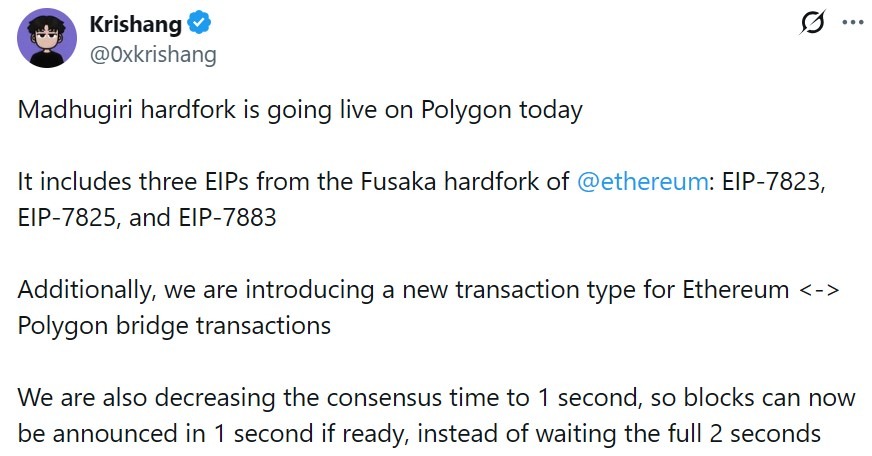
Source: Krishang Shah

New update reinforces Polygon for stablecoins and RWAs

With Madhugiri now live, Polygon aims to reinforce its infrastructure while materially improving its performance. These are prerequisites for high-frequency and high-trust use cases, such as real-world asset (RWA) tokenization and stablecoins.

Aishwary Gupta, the global head of payments and RWAs at Polygon Labs, previously forecasted a “stablecoin supercycle.”

Gupta said there will be a surge of “at least 100,000 stablecoins” in the next five years. However, he said this would not only be about minting tokens and must have a corresponding utility like yield.

Gupta also advocated for more transparency and accountability in the RWA sector. He previously argued that RWA numbers are meaningless if the assets cannot be audited, settled or traded.

“When transparency and accountability are established, RWAs will reach even greater heights, unlocking trillions in institutional capital,” he wrote.

Related: Polygon co-founder mulls resurrecting MATIC a year after POL rebrand

Hard fork follows major Heimdall upgrade

The upgrade comes on the heels of rapid prior improvements. On July 10, Polygon deployed Heimdall 2.0, dubbed by Polygon Foundation CEO Sandeep Nailwal as the network’s “most technically complex” hard fork since its launch.

The update reduced transaction finality times from one to two minutes to roughly five seconds.

However, on Sept. 10, the network experienced a significant disruption when a bug caused finality delays of 10 to 15 minutes, affecting validator sync, remote procedure call services and third-party tooling. Despite this, the team assured the community that blocks were still running.

On Sept. 11, the Polygon Foundation announced that the consensus and finality functions had been restored through a hard fork. With the update, nodes were no longer stuck, while checkpoints and milestones were finalized as expected.

Magazine: Ethereum’s Fusaka fork explained for dummies: What the hell is PeerDAS?

Related Reads

Don't Lose Heart in Crypto, Be a Pragmatic Optimist

Nic Carter, co-founder of Castle Island Ventures, responds to Ken Chan’s pessimistic essay “I Wasted 8 Years of My Life in Crypto” by arguing for a pragmatic and optimistic outlook on the crypto industry. While acknowledging that Chan’s critique—that crypto has devolved into a massive speculative casino rather than a decentralized financial system—contains truth, Carter contends that the industry still holds meaningful purpose. Carter identifies five core visions driving crypto: restoring sound money (e.g., Bitcoin as a global monetary asset), encoding business logic via smart contracts, making digital property real (e.g., NFTs and Web3), improving capital market efficiency, and expanding global financial inclusion. He admits that many early idealistic expectations—such as hyperbitcoinization or revolutionary digital ownership—have not materialized, and that much of the current activity involves speculation, memecoins, and gambling. However, Carter advocates for “pragmatic optimism.” He argues that speculative excess and financial nihilism are unfortunate but inevitable byproducts of building permissionless, open financial infrastructure. The key is to focus on the real, albeit gradual, progress: Bitcoin’s adoption, functional stablecoins, decentralized exchanges, and improved financial access in developing regions—without succumbing to either utopian fantasies or cynical despair.

marsbit1m ago

Don't Lose Heart in Crypto, Be a Pragmatic Optimist

marsbit1m ago

Bitcoin's Losses Against the Dollar Are 10 Times Lower Than Against the Ruble. How Did This Happen

The article analyzes Bitcoin's (BTC) significant 30%+ depreciation against the Russian ruble since the start of 2025, contrasting it with much smaller losses against major currencies like the US dollar (~3%). This disparity is attributed to the ruble's own substantial strengthening, which appreciated roughly 25% against the dollar over the same period. Consequently, while Bitcoin hit new all-time highs against the dollar, euro, and yen in late 2024, it failed to do so against the ruble. The piece further explains that the Russian ruble/Bitcoin exchange rate is not directly traded on major spot markets. Instead, it is calculated by converting the BTC/USD price using the current USD/RUB rate, leading to potential pricing discrepancies. This indirect method, coupled with the absence of major exchanges like Binance from the Russian market, has fragmented liquidity. The market now heavily relies on peer-to-peer (P2P) exchanges and over-the-counter trades using stablecoins like USDT, which often trade at a premium to the official dollar rate. These conditions have created a challenging environment, increasing fraud and "gray" schemes in P2P markets. The situation is further complicated by recent Russian legislation that impose criminal penalties for using "dropper" bank accounts (money mules) and restrict cash withdrawals, which are expected to significantly alter the crypto exchange landscape.

RBK-crypto14m ago

Bitcoin's Losses Against the Dollar Are 10 Times Lower Than Against the Ruble. How Did This Happen

RBK-crypto14m ago

Trading

Spot
Futures
活动图片